← All case work
05 · INTERACTIVE CONTENT SYSTEMS
Game planning and content production
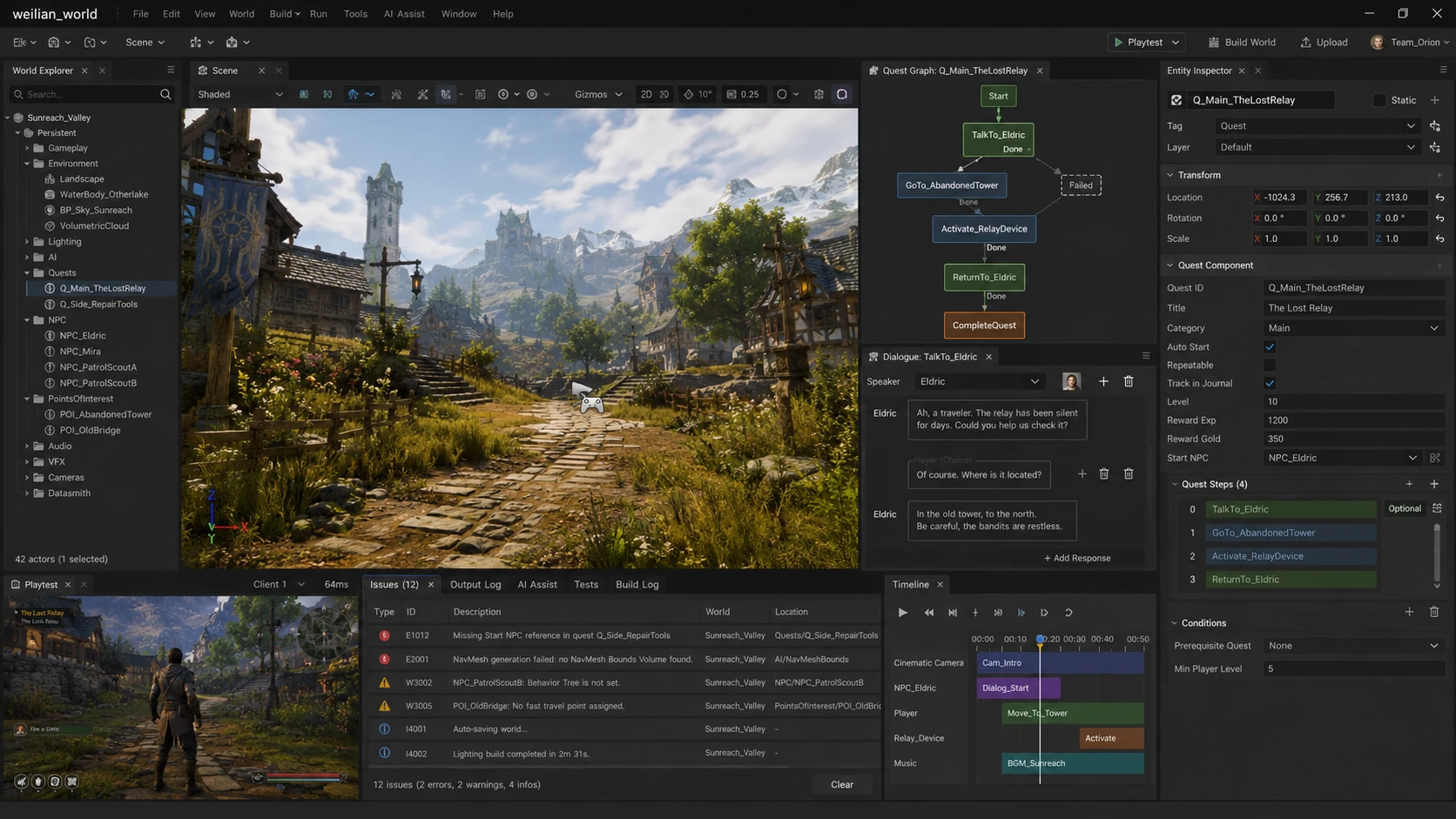
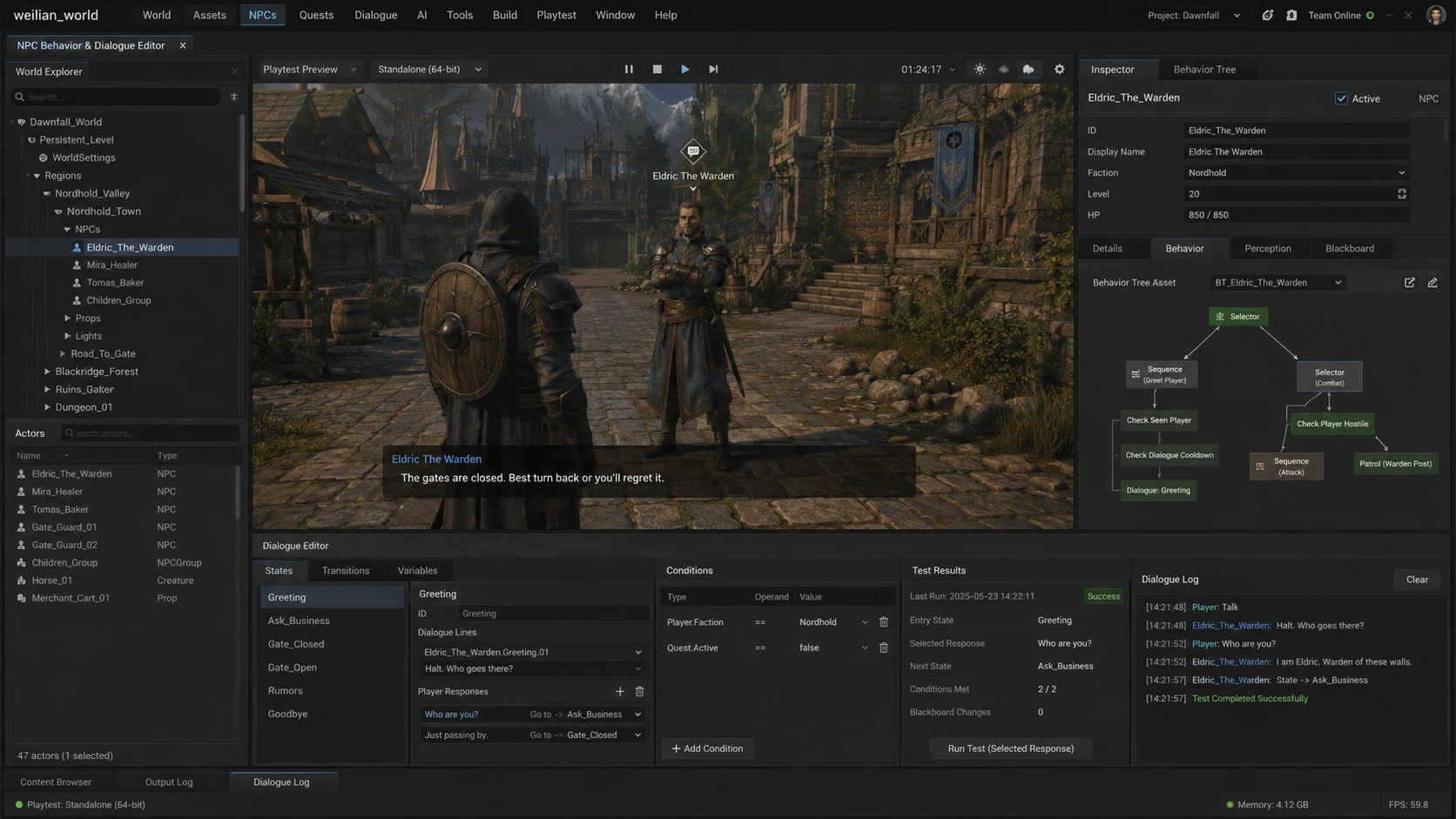
Tools for game teams to manage worlds, quests, characters, dialogue, and runtime rules as structured, testable content.
Keep narrative, design, art, and engineering aligned around the same content model while detecting conflicts and version changes.
Custom engineeringCase workWorking prototype
WEILIAN ANXIN / world-enginePRODUCT INTERFACE
THE BUSINESS PROBLEM
Where daily work and management decisions become harder.
Consistency becomes difficult at content scale
Designers need constrained AI assistance
Generated content must connect to an existing engine
Where it fits
Built for work that
standard software misses.
We start with one high-value workflow, make its scope and operating risks explicit, and expand only after the first version is proven in use.
World, quest, and dialogue material is scattered
Consistency becomes difficult at content scale
Designers need constrained AI assistance
Generated content must connect to an existing engine
Operating flow
How work moves
through the system.
Roles, permissions, review points, and exception rules are adapted to the customer’s current operating model.
01→
Structure the worldModel locations, factions, characters, events, and established rules.
02→
Design quests and rolesDefine triggers, goals, rewards, character state, and dialogue relationships.
03→
Generate constrained optionsCreate candidate content only inside approved lore, state, and asset boundaries.
04→
Check conflictsDetect contradictions, missing conditions, unreachable nodes, and broken references.
05→
Edit and approveLet the production team revise copy, values, and flow before acceptance.
06✓
Validate in the engineExport structured content and test it in the target runtime.
CONTENT GRAPH
Lore, quests, and characters evolve in one rule space
Select a stage to inspect the operating rhythm that distinguishes this class of system.
Product surfaces
Inspect the controls,
states, and outputs.
These interfaces come from real business workflows. Public screens remove customer-sensitive data while preserving the operating structure.
Scope
Choose the modules
the workflow requires.
Modules can be delivered independently or connected to existing software after discovery confirms the data and permission boundaries.
Engineering decisions
Technology follows
the operating requirement.
Data volume, latency, security, and current systems determine the final architecture.
Structured world model
Represent places, people, factions, events, and rules as queryable relationships.
Constrained generation
Keep AI output inside approved lore, task state, and available assets.
Runtime feedback loop
Use playtest and telemetry signals to locate blocked tasks and dialogue defects.
Project boundaries
Scope and operating
conditions stay explicit.
- The page presents production tooling, not a complete commercial game.
- Final creative work remains subject to the customer team’s review and ownership.
- Integration depends on engine version, project structure, and asset pipeline.
IMPLEMENTATION & HANDOVER
Agree the scope, integration needs and ongoing support.
Agree development, deployment, training, maintenance and customer involvement, with cost and acceptance documented for the project.
Delivery scope
- Editor and content model
- Generation and validation tools
- Engine import/export plug-in
- Testing and versioning design
Existing systems and information
- Unity / Unreal / custom engines
- Git / Perforce
- Asset management
- Local or cloud models
- Testing and telemetry
- Design sheets and content databases
START A CONVERSATION
Start with the work that most needs to improve.
Tell us how the work happens today, where time is lost, which systems you use and what needs to improve. We can then discuss scope, implementation and collaboration.
Discuss your business needs ↗