← All case work
08 · EXPERIMENT & SIMULATION
Data modelling and research simulation
Reproducible systems for prediction, classification, factor research, strategy testing, and model comparison.
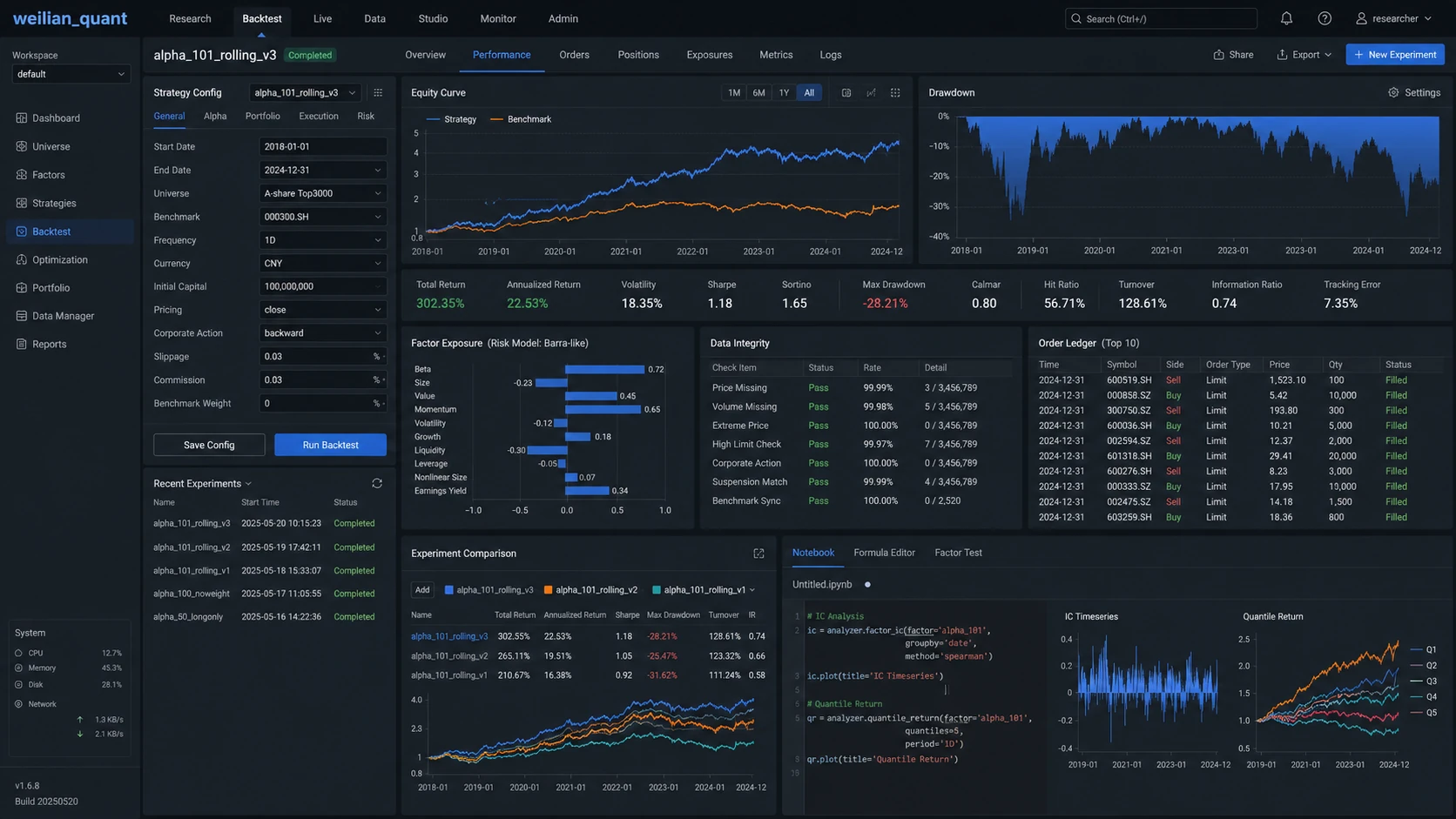
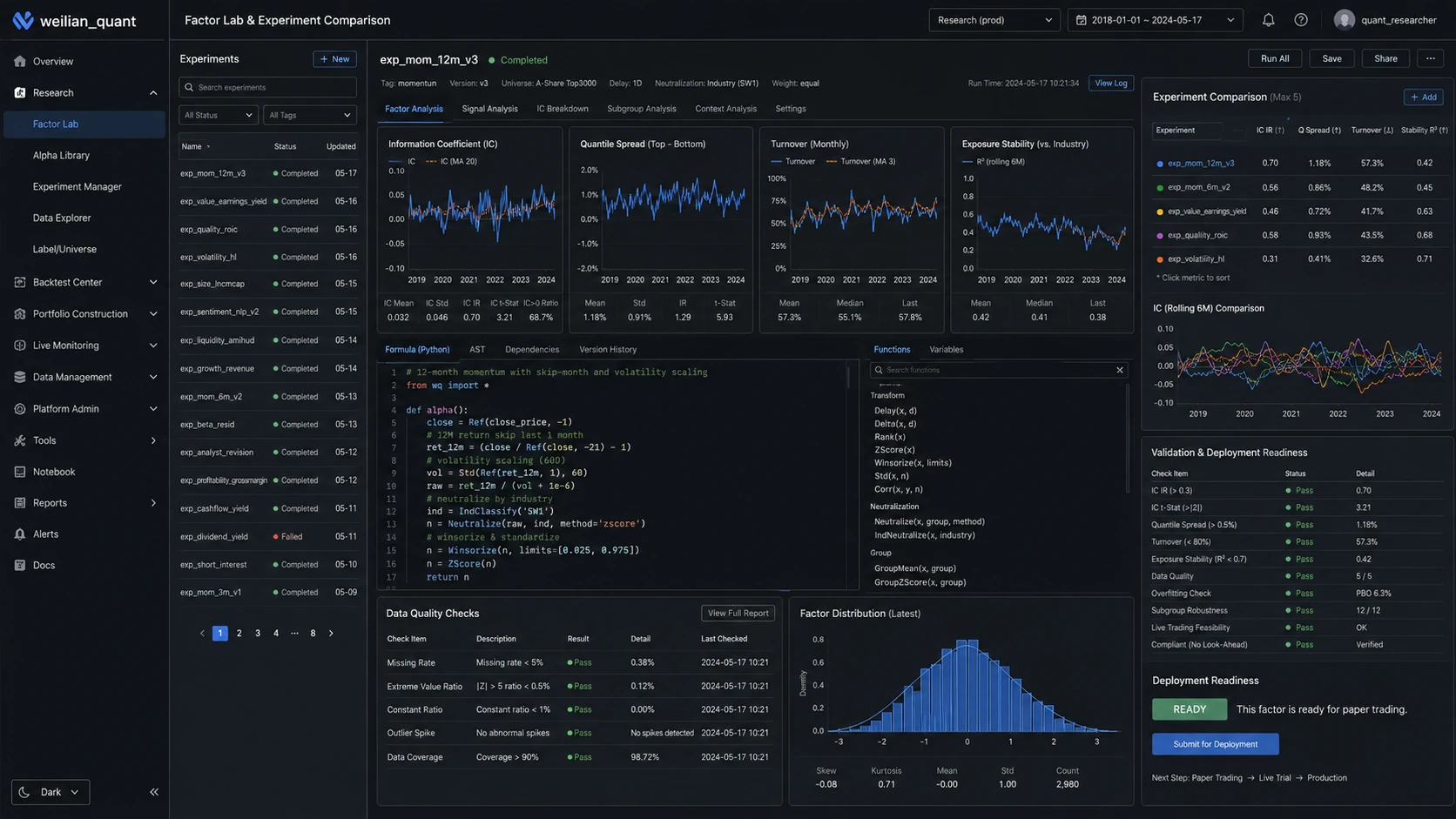
Keep data versions, experiment parameters, cost assumptions, and risk exposure together so results can be reproduced and challenged.
Custom engineeringCase workData path validation
WEILIAN ANXIN / quant-simulationPRODUCT INTERFACE
THE BUSINESS PROBLEM
Where daily work and management decisions become harder.
Backtests omit cost, liquidity, or data bias
Several model and factor versions must be compared
A research process needs to become a team product
Where it fits
Built for work that
standard software misses.
We start with one high-value workflow, make its scope and operating risks explicit, and expand only after the first version is proven in use.
Experiments are scattered across scripts and sheets
Backtests omit cost, liquidity, or data bias
Several model and factor versions must be compared
A research process needs to become a team product
Operating flow
How work moves
through the system.
Roles, permissions, review points, and exception rules are adapted to the customer’s current operating model.
01→
Fix the data versionRecord the sample, fields, cleaning steps, and information available at the time.
02→
Build features and factorsCreate candidate signals and test missingness, bias, and stability.
03→
Train and test independentlyUse time-based splits and out-of-sample data for evaluation.
04→
Add real-world constraintsInclude fees, slippage, capacity, trading halts, and risk limits.
05→
Compare risk and attributionInspect returns, drawdown, exposure, and the sources of variation.
06✓
Register the experimentSave data, code, parameters, outcomes, and the next falsifiable check.
EXPERIMENT RECORD
Data, parameters, constraints, and outcomes stay reproducible
Select a stage to inspect the operating rhythm that distinguishes this class of system.
Product surfaces
Inspect the controls,
states, and outputs.
These interfaces come from real business workflows. Public screens remove customer-sensitive data while preserving the operating structure.
Scope
Choose the modules
the workflow requires.
Modules can be delivered independently or connected to existing software after discovery confirms the data and permission boundaries.
Engineering decisions
Technology follows
the operating requirement.
Data volume, latency, security, and current systems determine the final architecture.
Reproducible experiment tracking
Record data, code, parameters, environment, and outcomes for team review.
Out-of-sample robustness
Use time splits, stress scenarios, and sensitivity tests to reduce overfitting.
Realistic operating constraints
Represent fees, slippage, capacity, halts, and risk exposure in simulation.
Project boundaries
Scope and operating
conditions stay explicit.
- Public screens remove strategy, performance, and commercially sensitive information.
- Historical testing does not predict future performance and no return is promised.
- Data licensing, model use, and production execution require separate authorisation.
IMPLEMENTATION & HANDOVER
Agree the scope, integration needs and ongoing support.
Agree development, deployment, training, maintenance and customer involvement, with cost and acceptance documented for the project.
Delivery scope
- Data and experiment pipeline
- Research and backtest workspace
- Metrics, risk, and attribution
- Testing and deployment documentation
Existing systems and information
- Market and alternative data
- Python / notebooks / warehouse
- Model training platforms
- Schedulers and compute
- BI and reporting
- Permissions, audit, and version control
START A CONVERSATION
Start with the work that most needs to improve.
Tell us how the work happens today, where time is lost, which systems you use and what needs to improve. We can then discuss scope, implementation and collaboration.
Discuss your business needs ↗