← All case work
01 · OPERATIONS & INTERNAL SYSTEMS
Orders, inventory and business management
Custom software for orders, inventory, suppliers, approvals, and operational exceptions—designed around the way each business actually works.
Turn work scattered across spreadsheets, chats, and disconnected systems into a tracked operating flow with clear ownership and approval.
Custom engineeringCase workPrivate testing
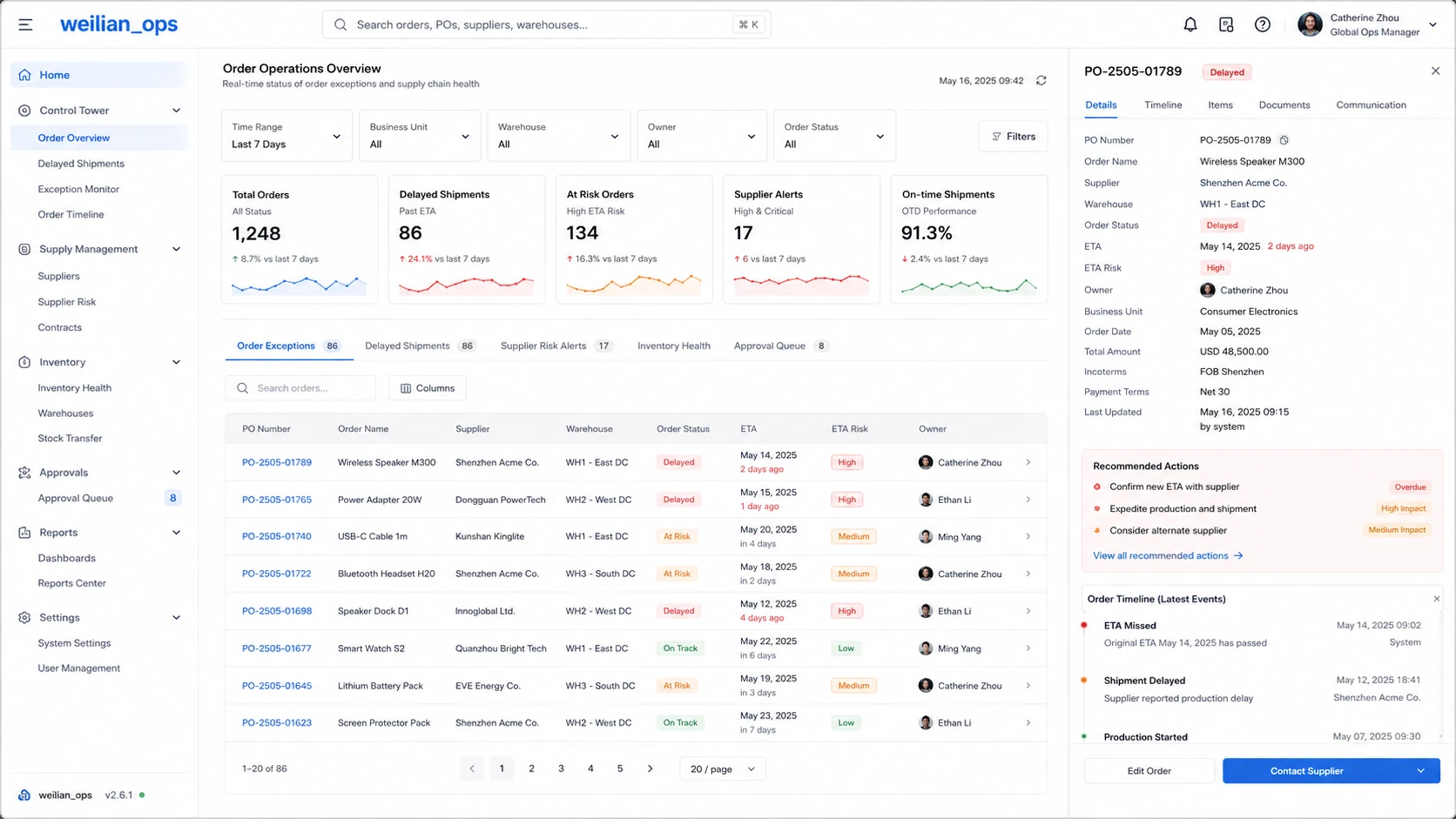
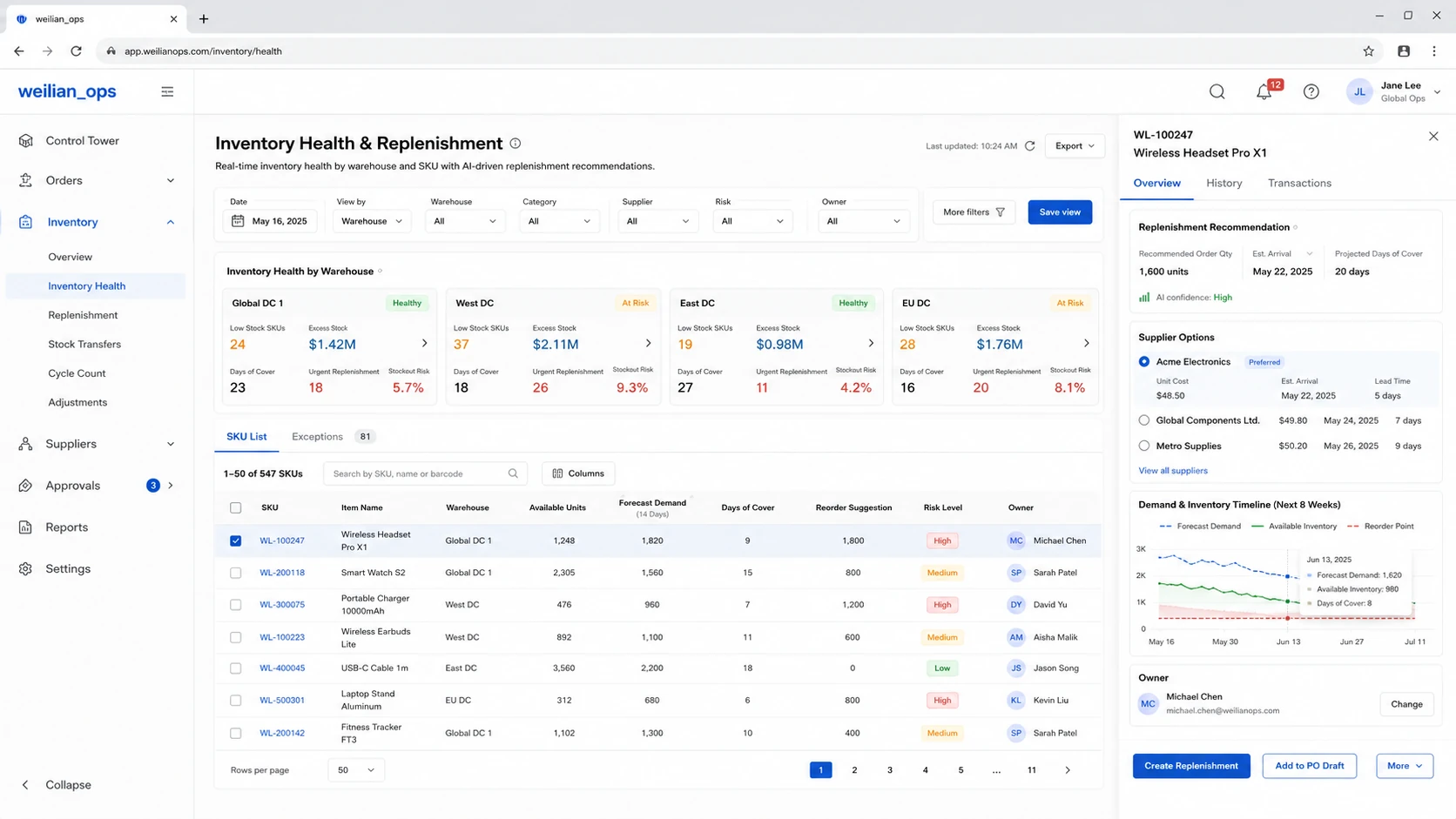
WEILIAN ANXIN / operations-systemPRODUCT INTERFACE
THE BUSINESS PROBLEM
Where daily work and management decisions become harder.
Supplier lead times and risk lack a shared view
Approvals cross several teams and systems
AI must connect to an existing ERP or CRM
Where it fits
Built for work that
standard software misses.
We start with one high-value workflow, make its scope and operating risks explicit, and expand only after the first version is proven in use.
Orders and inventory depend on manual updates
Supplier lead times and risk lack a shared view
Approvals cross several teams and systems
AI must connect to an existing ERP or CRM
Operating flow
How work moves
through the system.
Roles, permissions, review points, and exception rules are adapted to the customer’s current operating model.
01→
Connect business dataRead the order, stock, supplier, and system records required for the task.
02→
Check exceptionsFlag shortages, lead-time changes, missing fields, and incomplete documents.
03→
Prepare a responseApply business rules and use AI to explain causes and available actions.
04→
Request owner approvalRoute commercial commitments and cross-team decisions to the accountable person.
05→
Update connected systemsWrite approved status, notes, and actions back to ERP, CRM, or internal tools.
06✓
Keep the operating recordRetain inputs, reasons, approvals, and the final outcome for review.
EXCEPTION CONTROL
From operating signal to accountable owner
Select a stage to inspect the operating rhythm that distinguishes this class of system.
Product surfaces
Inspect the controls,
states, and outputs.
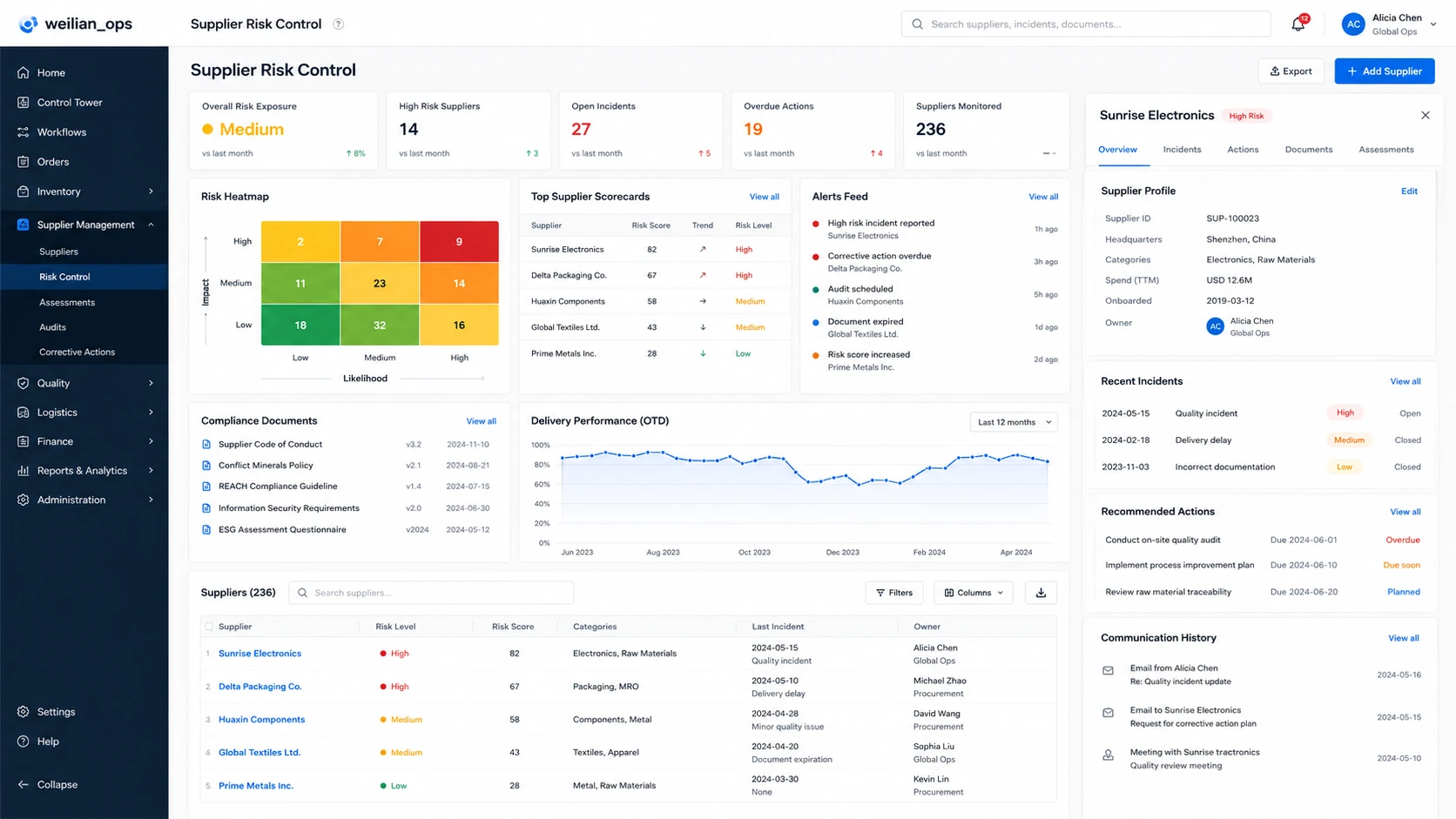
These interfaces come from real business workflows. Public screens remove customer-sensitive data while preserving the operating structure.
Scope
Choose the modules
the workflow requires.
Modules can be delivered independently or connected to existing software after discovery confirms the data and permission boundaries.
Engineering decisions
Technology follows
the operating requirement.
Data volume, latency, security, and current systems determine the final architecture.
Event-driven operating model
Orders, inventory, and supplier changes trigger work for the right role.
Rules with model assistance
Rules control money, permissions, and state; AI reads material and prepares explanations.
Replayable activity record
Inputs, sources, approvals, system actions, and outcomes remain inspectable.
Project boundaries
Scope and operating
conditions stay explicit.
- Public screens remove customer and operating-sensitive information.
- Payments, contracts, and production writes follow project-specific permission and approval rules.
- Final modules, integrations, and deployment are defined after discovery.
IMPLEMENTATION & HANDOVER
Agree the scope, integration needs and ongoing support.
Agree development, deployment, training, maintenance and customer involvement, with cost and acceptance documented for the project.
Delivery scope
- Business object and workflow design
- Role-based operating workspace
- System integration and migration
- Testing, release, and operating documentation
Existing systems and information
- ERP / CRM / MES / OA
- Databases and enterprise APIs
- Excel / CSV / PDF
- Enterprise messaging
- SSO and role permissions
- Private or dedicated cloud
START A CONVERSATION
Start with the work that most needs to improve.
Tell us how the work happens today, where time is lost, which systems you use and what needs to improve. We can then discuss scope, implementation and collaboration.
Discuss your business needs ↗