← All case work
07 · KNOWLEDGE & EVIDENCE
Business knowledge and market research
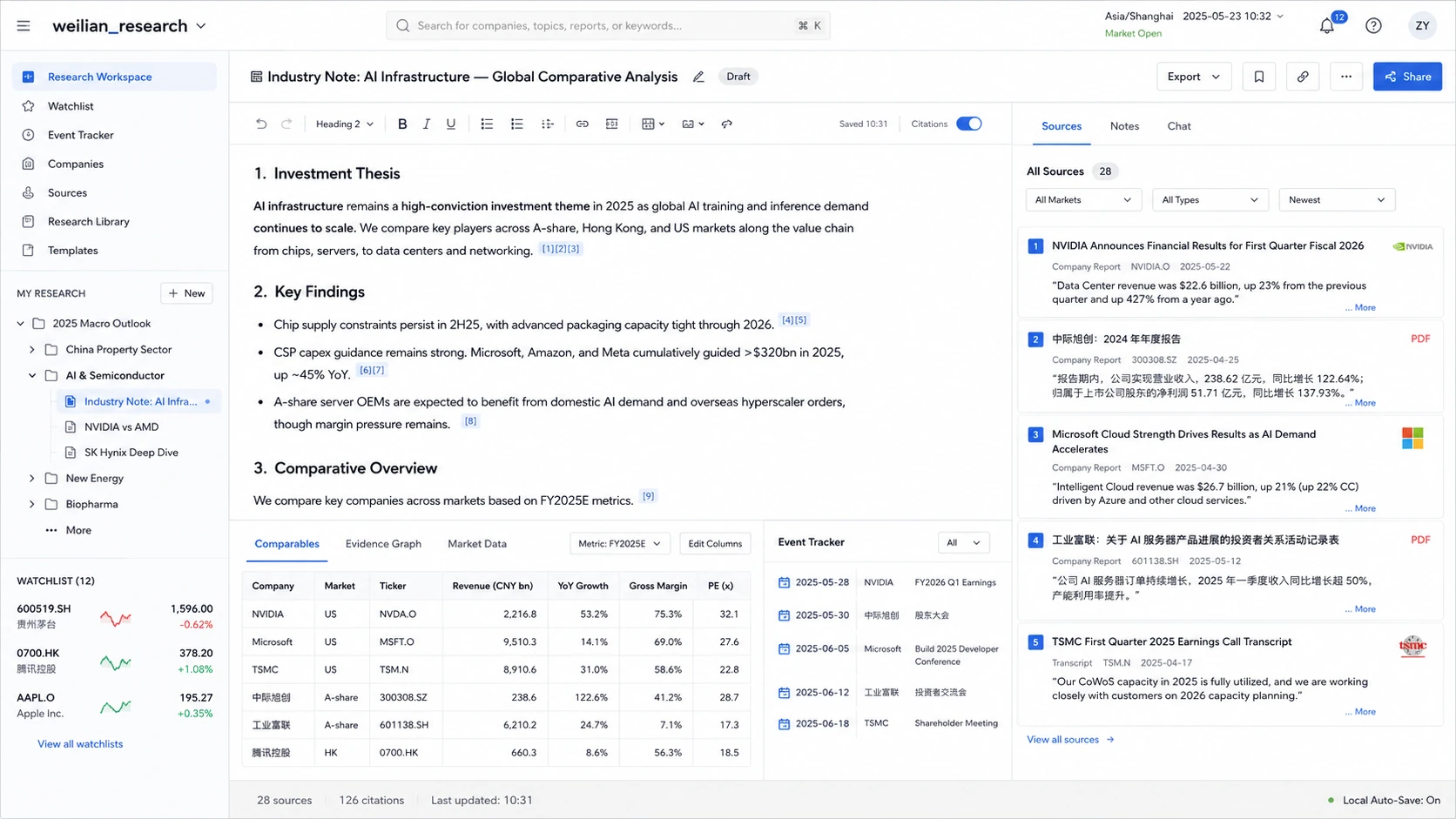
Turn documents, filings, financial data, research notes, and external sources into a permission-aware system for search, citation, and ongoing analysis.
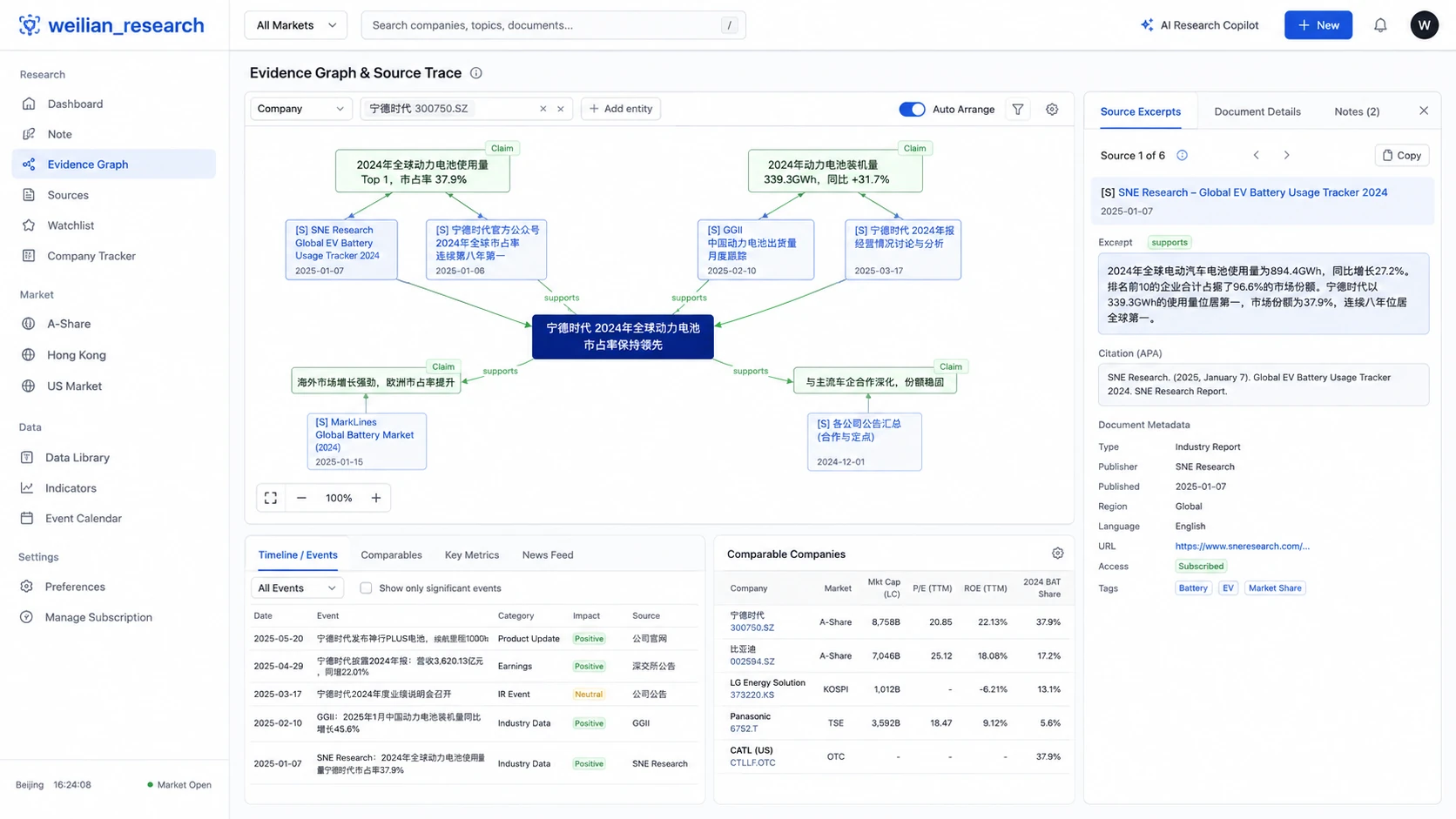
Let every judgement return to its source, date, and context—while preserving counter-evidence, disagreement, and follow-up work.
Custom engineeringCase workPrivate testing
WEILIAN ANXIN / market-intelligencePRODUCT INTERFACE
THE BUSINESS PROBLEM
Where daily work and management decisions become harder.
Knowledge answers require dependable citation
Markets and metrics use inconsistent definitions
Conclusions and counter-evidence lack version control
Where it fits
Built for work that
standard software misses.
We start with one high-value workflow, make its scope and operating risks explicit, and expand only after the first version is proven in use.
Research material is difficult to reuse
Knowledge answers require dependable citation
Markets and metrics use inconsistent definitions
Conclusions and counter-evidence lack version control
Operating flow
How work moves
through the system.
Roles, permissions, review points, and exception rules are adapted to the customer’s current operating model.
01→
Connect documents and dataImport files, tables, images, filings, notes, and external data.
02→
Parse and indexExtract text, tables, dates, and sources with permissions and retrieval indexes.
03→
Frame the research questionCreate a question, comparison, monitoring task, or research brief.
04→
Retrieve support and counter-evidenceSearch relevant sources, contrary views, and still-missing information.
05→
Review with an analystCheck citations, dates, and reasoning before accepting a conclusion.
06✓
Version the conclusionSave the new view and schedule the data or events that require monitoring.
EVIDENCE CHAIN
Question, source, counter-evidence, and conclusion remain linked
Select a stage to inspect the operating rhythm that distinguishes this class of system.
Product surfaces
Inspect the controls,
states, and outputs.
These interfaces come from real business workflows. Public screens remove customer-sensitive data while preserving the operating structure.
Scope
Choose the modules
the workflow requires.
Modules can be delivered independently or connected to existing software after discovery confirms the data and permission boundaries.
Engineering decisions
Technology follows
the operating requirement.
Data volume, latency, security, and current systems determine the final architecture.
Hybrid retrieval and reranking
Combine keyword, vector, and structured filters for professional material.
Evidence-level citation
Tie answers to source excerpts, document versions, and dates.
Point-in-time consistency
Organise research around information available at the time of the decision.
Project boundaries
Scope and operating
conditions stay explicit.
- Public screens remove company, data, and opinion-sensitive information.
- External sources remain subject to permission and copyright terms.
- The system supports research work and does not provide investment advice or guaranteed outcomes.
IMPLEMENTATION & HANDOVER
Agree the scope, integration needs and ongoing support.
Agree development, deployment, training, maintenance and customer involvement, with cost and acceptance documented for the project.
Delivery scope
- Knowledge and retrieval system
- Research workspace
- Evidence and citation mechanism
- Data integration and evaluation report
Existing systems and information
- PDF / Word / Excel / images
- Enterprise drives and knowledge tools
- Databases and market-data APIs
- OCR and document parsing
- SSO / permissions / watermarking
- Reporting and research workflows
START A CONVERSATION
Start with the work that most needs to improve.
Tell us how the work happens today, where time is lost, which systems you use and what needs to improve. We can then discuss scope, implementation and collaboration.
Discuss your business needs ↗