← All case work
04 · MULTIMODAL PRODUCTION
Marketing content and production coordination
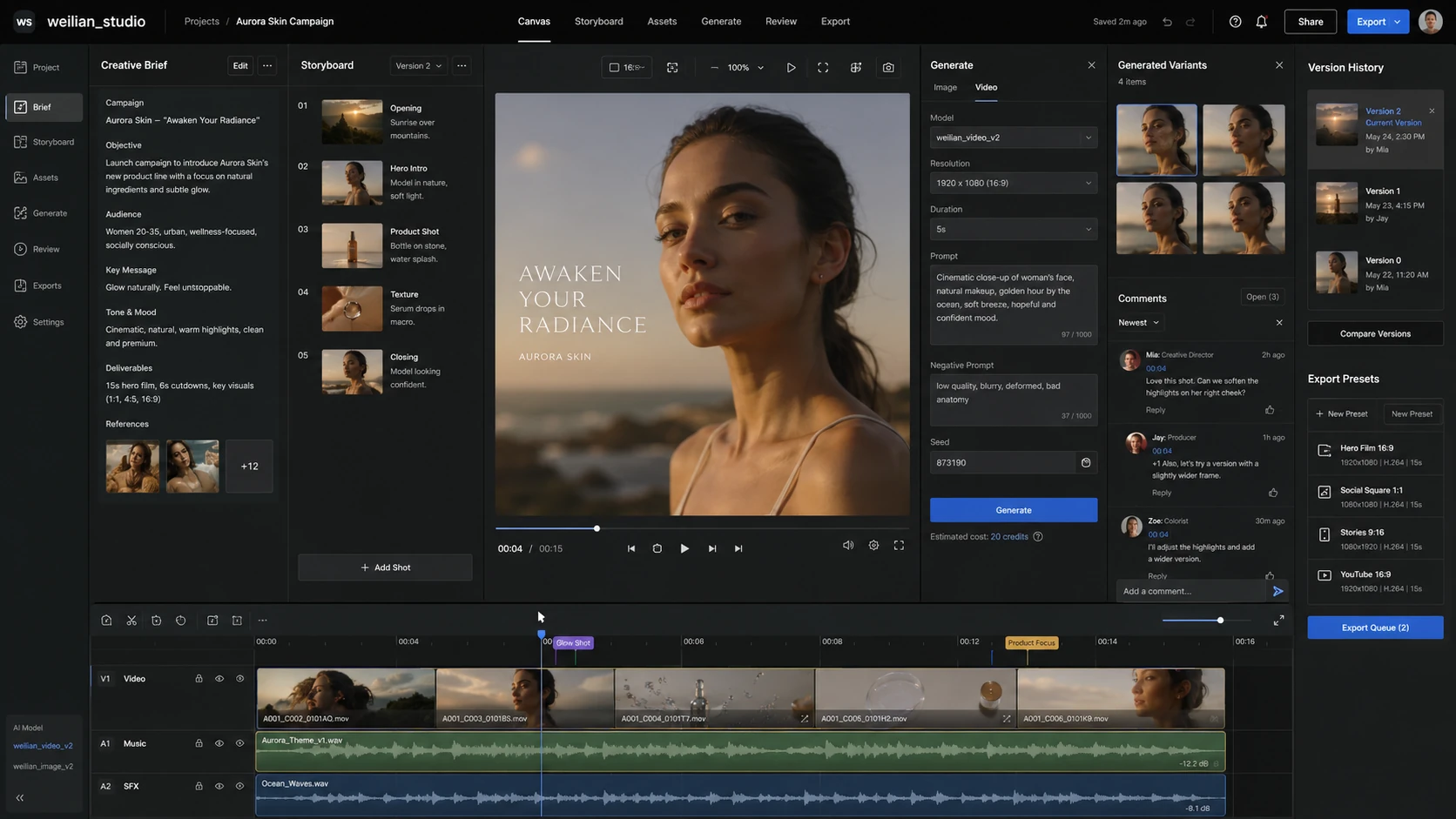
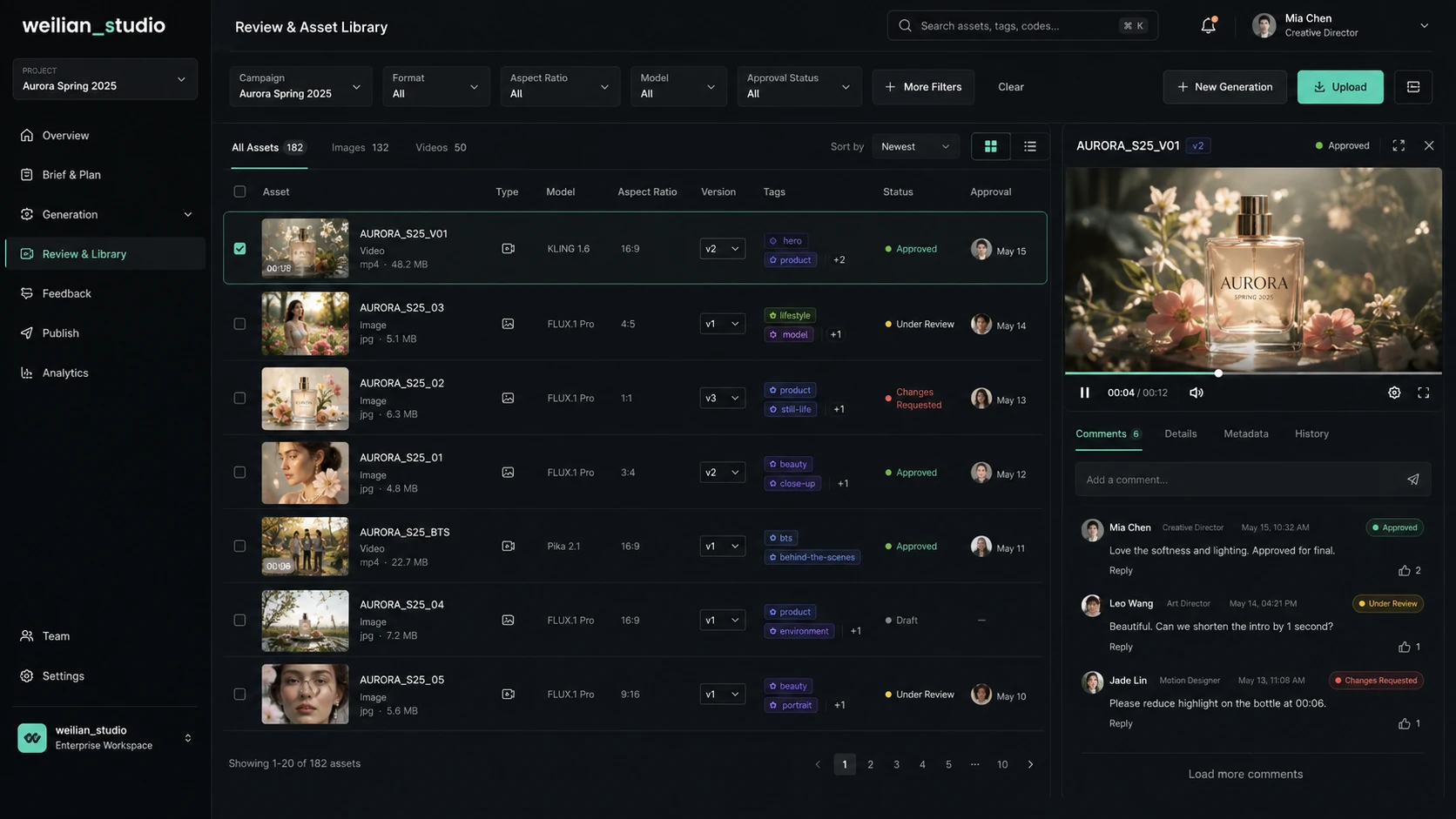
A production workflow for briefs, scripts, images, video, reviews, and asset management—with brand rules carried through every version.
Reduce scattered assets and revision loops by keeping brand constraints, feedback, versions, and delivery formats in one flow.
Custom engineeringCase workWorking prototype
WEILIAN ANXIN / creative-studioPRODUCT INTERFACE
THE BUSINESS PROBLEM
Where daily work and management decisions become harder.
Brand rules and past work are hard to reuse
Generation tools are disconnected from review
Version history and delivery records must be retained
Where it fits
Built for work that
standard software misses.
We start with one high-value workflow, make its scope and operating risks explicit, and expand only after the first version is proven in use.
Teams produce many channel-specific assets
Brand rules and past work are hard to reuse
Generation tools are disconnected from review
Version history and delivery records must be retained
Operating flow
How work moves
through the system.
Roles, permissions, review points, and exception rules are adapted to the customer’s current operating model.
01→
Capture the briefRecord audience, channel, brand constraints, source assets, and output specifications.
02→
Build script and storyboardTurn the direction into copy, shots, scenes, and audio requirements.
03→
Generate mediaRoute tasks to suitable models and retain inputs and generation parameters.
04→
Organise variantsPlace alternatives in one job so teams can compare copy, image, and format.
05→
Review with the teamDesign, brand, and business owners annotate and approve changes together.
06✓
Prepare channel deliveryExport final files to the required size, format, bitrate, and naming rules.
PRODUCTION LINE
Briefs, versions, and review stay connected
Select a stage to inspect the operating rhythm that distinguishes this class of system.
Product surfaces
Inspect the controls,
states, and outputs.
These interfaces come from real business workflows. Public screens remove customer-sensitive data while preserving the operating structure.
Scope
Choose the modules
the workflow requires.
Modules can be delivered independently or connected to existing software after discovery confirms the data and permission boundaries.
Engineering decisions
Technology follows
the operating requirement.
Data volume, latency, security, and current systems determine the final architecture.
Multimodal workflow orchestration
Coordinate text, image, video, and audio models in one stateful job.
Brand constraint checks
Use approved references and rules to check copy, colour, subject, and format.
Version lineage
Track the brief, model, prompt, source assets, and human edits behind each output.
Project boundaries
Scope and operating
conditions stay explicit.
- Public screens remove brand, people, and customer-sensitive information.
- Copyright, likeness, trademark, and platform rules are checked per project.
- Output quality depends on source material, model capability, and review standards.
IMPLEMENTATION & HANDOVER
Agree the scope, integration needs and ongoing support.
Agree development, deployment, training, maintenance and customer involvement, with cost and acceptance documented for the project.
Delivery scope
- Production workspace
- Model and provider routing
- Review and asset library
- Channel export and operating guide
Existing systems and information
- Image and video model providers
- DAM and asset libraries
- Object storage and CDN
- Design and editing tools
- Review and approval
- Commerce and social publishing
START A CONVERSATION
Start with the work that most needs to improve.
Tell us how the work happens today, where time is lost, which systems you use and what needs to improve. We can then discuss scope, implementation and collaboration.
Discuss your business needs ↗