← All case work
03 · COMMERCE INTELLIGENCE
Ecommerce sourcing and business analysis
Connect market, product, supplier, and operating data to support opportunity research, product decisions, and sourcing preparation.
Give teams a decision with visible sources, cost assumptions, and risk conditions—not an unexplained recommendation score.
Custom engineeringCase workData path validation
WEILIAN ANXIN / commerce-intelligencePRODUCT INTERFACE
THE BUSINESS PROBLEM
Where daily work and management decisions become harder.
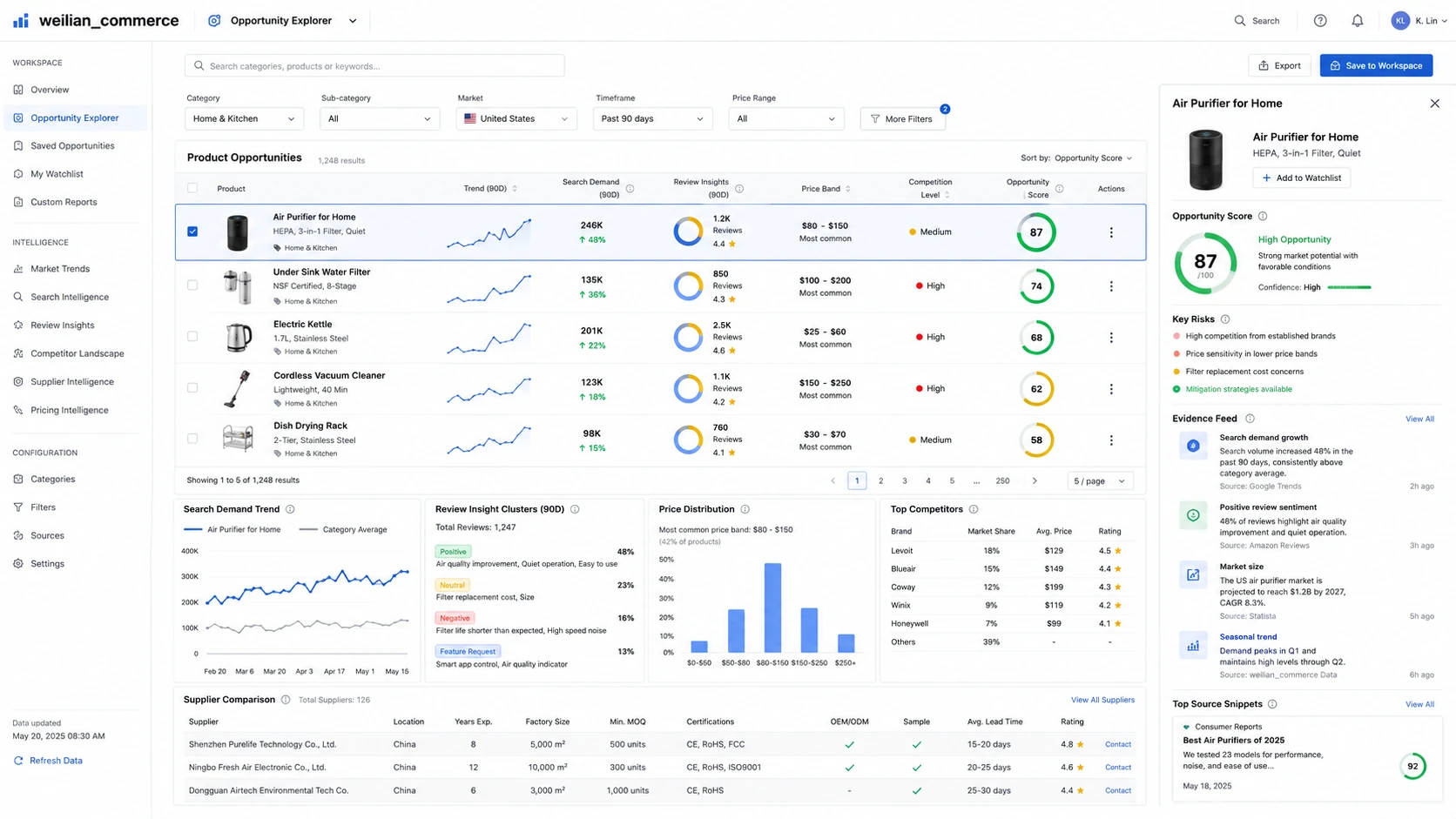
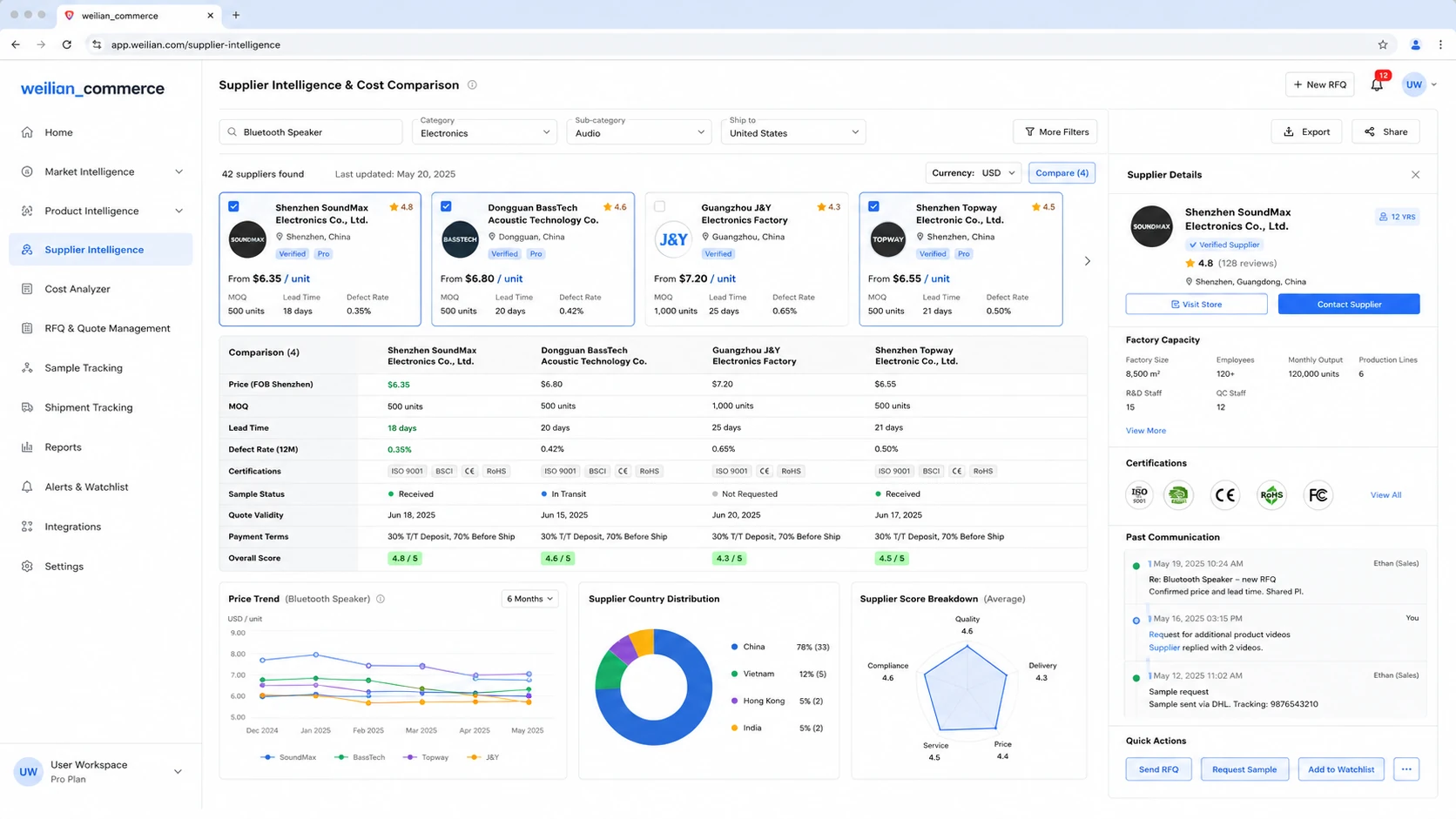
Supplier costs lack a common comparison basis
Market signals are disconnected from internal data
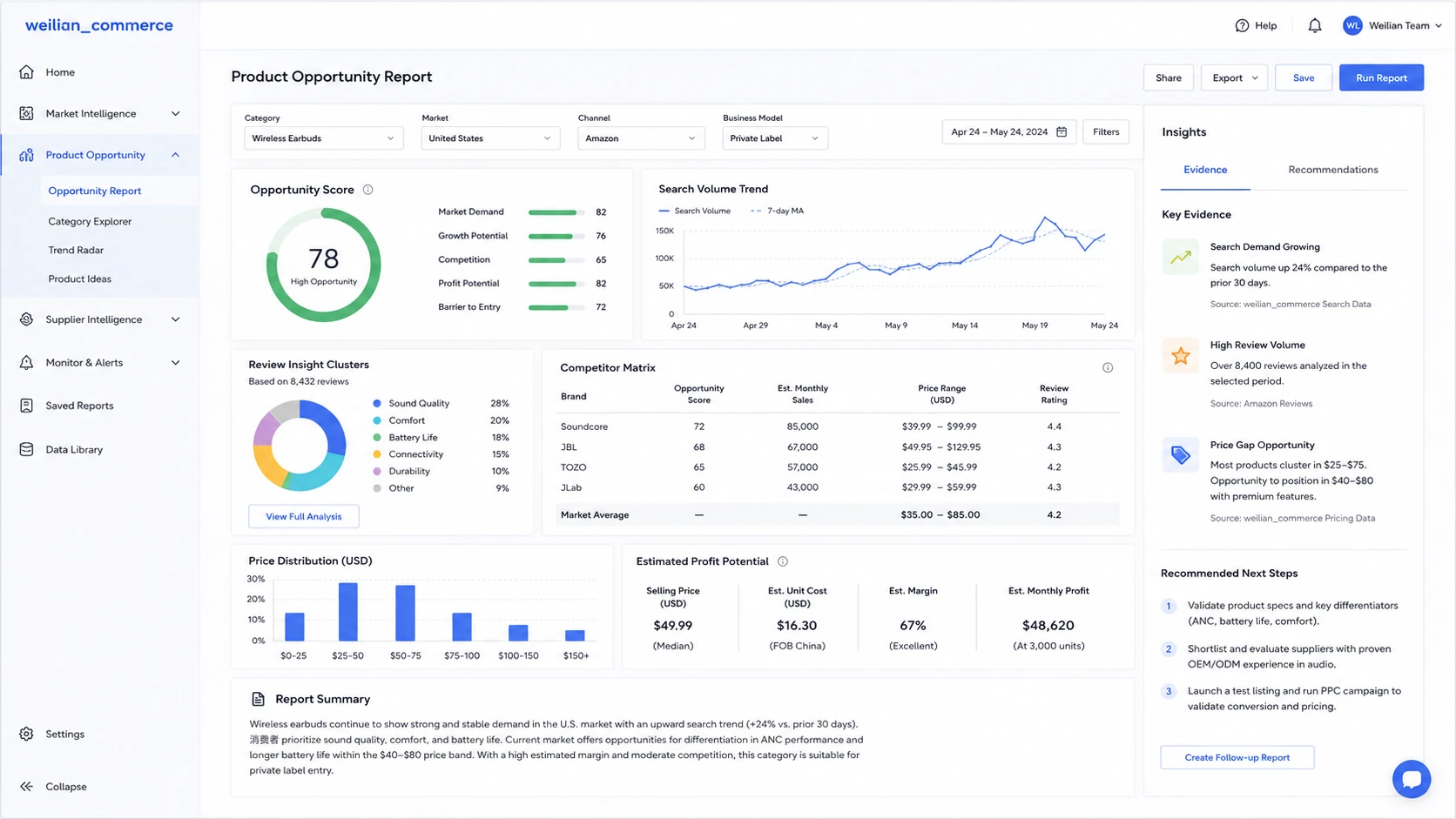
Teams need a reviewable opportunity report
Where it fits
Built for work that
standard software misses.
We start with one high-value workflow, make its scope and operating risks explicit, and expand only after the first version is proven in use.
Product selection depends on fragmented tools
Supplier costs lack a common comparison basis
Market signals are disconnected from internal data
Teams need a reviewable opportunity report
Operating flow
How work moves
through the system.
Roles, permissions, review points, and exception rules are adapted to the customer’s current operating model.
01→
Define the market questionSet the region, price band, product scope, and business decision.
02→
Collect relevant dataConnect market, product, advertising, supplier, and internal operating sources.
03→
Normalise entities and unitsAlign names, variants, currencies, dates, and measurement rules.
04→
Compare opportunity and riskAssess demand, competition, cost, lead time, and supply risk.
05→
Adjust business assumptionsLet operators change price, sourcing, logistics, returns, and marketing inputs.
06✓
Prepare an action reportPublish conclusions, sources, risks, and the next checks required.
DECISION RAIL
Sources, economics, and risk in one decision trail
Select a stage to inspect the operating rhythm that distinguishes this class of system.
Product surfaces
Inspect the controls,
states, and outputs.
These interfaces come from real business workflows. Public screens remove customer-sensitive data while preserving the operating structure.
Scope
Choose the modules
the workflow requires.
Modules can be delivered independently or connected to existing software after discovery confirms the data and permission boundaries.
Engineering decisions
Technology follows
the operating requirement.
Data volume, latency, security, and current systems determine the final architecture.
Multi-source entity resolution
Map products, brands, variants, and suppliers into consistent business objects.
Source-grounded analysis
Keep conclusions tied to source, date, and original evidence.
Scenario margin modelling
Compare commercial outcomes under different pricing and cost assumptions.
Project boundaries
Scope and operating
conditions stay explicit.
- Public screens remove customer and commercially sensitive information.
- Data-source access and collection frequency must follow platform rules.
- Commercial decisions still depend on each company’s economics and supply strategy.
IMPLEMENTATION & HANDOVER
Agree the scope, integration needs and ongoing support.
Agree development, deployment, training, maintenance and customer involvement, with cost and acceptance documented for the project.
Delivery scope
- Source and metric definitions
- Opportunity analysis workspace
- Supplier comparison module
- Exportable decision reports
Existing systems and information
- Commerce and advertising data
- Supplier and sourcing systems
- ERP / inventory / finance
- Third-party market data
- Excel / BI / warehouse
- Reporting and approval workflows
START A CONVERSATION
Start with the work that most needs to improve.
Tell us how the work happens today, where time is lost, which systems you use and what needs to improve. We can then discuss scope, implementation and collaboration.
Discuss your business needs ↗